Judges citation
The winner of the Peter Blazey Fellowship for 2027 is Amy McGuire, who will use the fellowship to complete her manuscript ‘State of Disappearance’. McGuire is an academic, author and journalist whose most recent essay collection, Black Witness, won the 2025 Queensland Premier’s Award for a Work of State Significance. ‘State of Disappearance’, which blends creative non-fiction, journalism and memoir, reflects on McGuire’s time sitting with the families of disappeared Aboriginal women over an extended period. Structured around five central Queensland cases, the author seeks to make visible the patterns that disappear Aboriginal people. Members of the Peter Blazey Fellowship panel recognised the timeliness and import of McGuire’s project and praised the originality and rigour of her method, which prioritises relationships with – and accountability towards – the manuscript’s key subjects and their families. Her writing evokes place and spirit of place with a powerful attention to creative non-fiction poetics. ‘State of Disappearance’ has the potential to enable a conversation of national significance, towards accountability and healing.
Amy McQuire’s full statement
“Thank you to the family of Peter Blazey and the selection committee for this enormous honour. In applying for and accepting the fellowship, I read some of the legacy of the iconic Peter Blazey, and in particular, his critical reportage in the fight against homophobic and racist violence. I also listened to the words of his partner Tim Herbert. Peter was the type of journalist that we should all aspire to be, a reporter who makes a continuing impact on the way we tell stories and in particular, how we write on violence.
His legacy reminds me of the importance of journalism as witnessing, and how our power is in your voices, in narrating our own experiences, in marginalised communities writing for our own people in the fight for justice. I also loved reading about Peter’s journalistic practice and how he came to the stories he reported on, which were some of the most important stories of the time.
I’m so honoured that I can be part of the tradition he wrote in, and I know the fellowship will continue to remind us of his enduring legacy and impact. This fellowship will enable to me to finish a piece of work I’ve been trying to write for over a decade, a piece of work that required me to first compete a PhD in order to begin, because I simply did not know how to report or write about it. It’s a work that speaks directly to the silencing of Aboriginal and Torres Strait Islander women, those who are here and those who have passed, those who speak to us in different ways, through acts of spirit.
The book is also grounded in my own childhood experiences as a Darumbal and South Sea Islander woman trying to understand the landscapes of violence we all live in and walk every day. I applied because I needed time to spend with the stories, and I’m so grateful that the generosity of the fellowship will enable me to do that.
Like Peter, who was one of the first on the scene to report on the disappearance of Harold Holt, these stories of disappearance came to me in different ways, in what I first termed ‘strange coincidences’, but which I later realised were signs of spirit, or signs of relationality between Black communities in Queensland.
Sometimes I have felt over the years that this work is too ambitious or that I am trying to say too many things, but this fellowship has been a reminder that writing and journalism has a purpose beyond just the individual.
Again, I want to thank Clive and Tim and the selection committee for this enormous honour.”
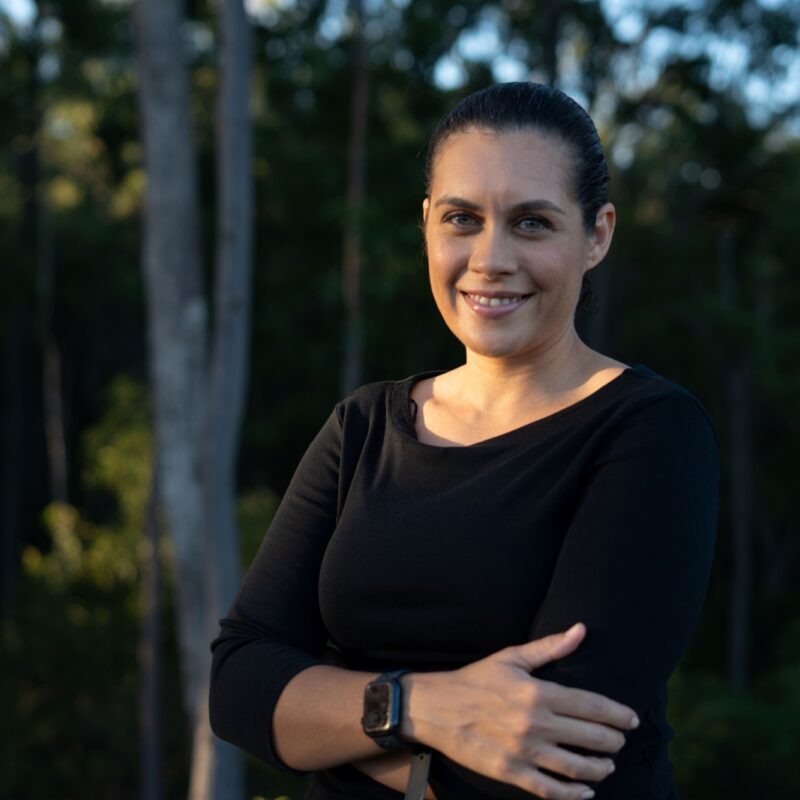
Amy McQuire – photo credit Jacob McQuire

